08 · AI INSIGHT · GPUs and Asset Value
An H100 Bought for $30,000 Retains About $20,000 Based on Reported Used Transactions
An H100 PCIe case with an assumed $30,000 purchase price: a reported transaction range of $16,000–24,000 and the calculation of investment recovery
In this article
- 1. Start by calculating what remains of $30,000
- 2. Why do internet listings still ask $30,000?
- 3. Why newer GPUs put downward pressure on older prices
- 4. A $10,000 price decline can still leave a profitable investment
- 5. The hold-or-sell decision uses a different comparison
- 6. GPU prices do not all fall at the same rate
- 7. Conclusion: about $20,000 remains; operations must recover the rest
- Sources
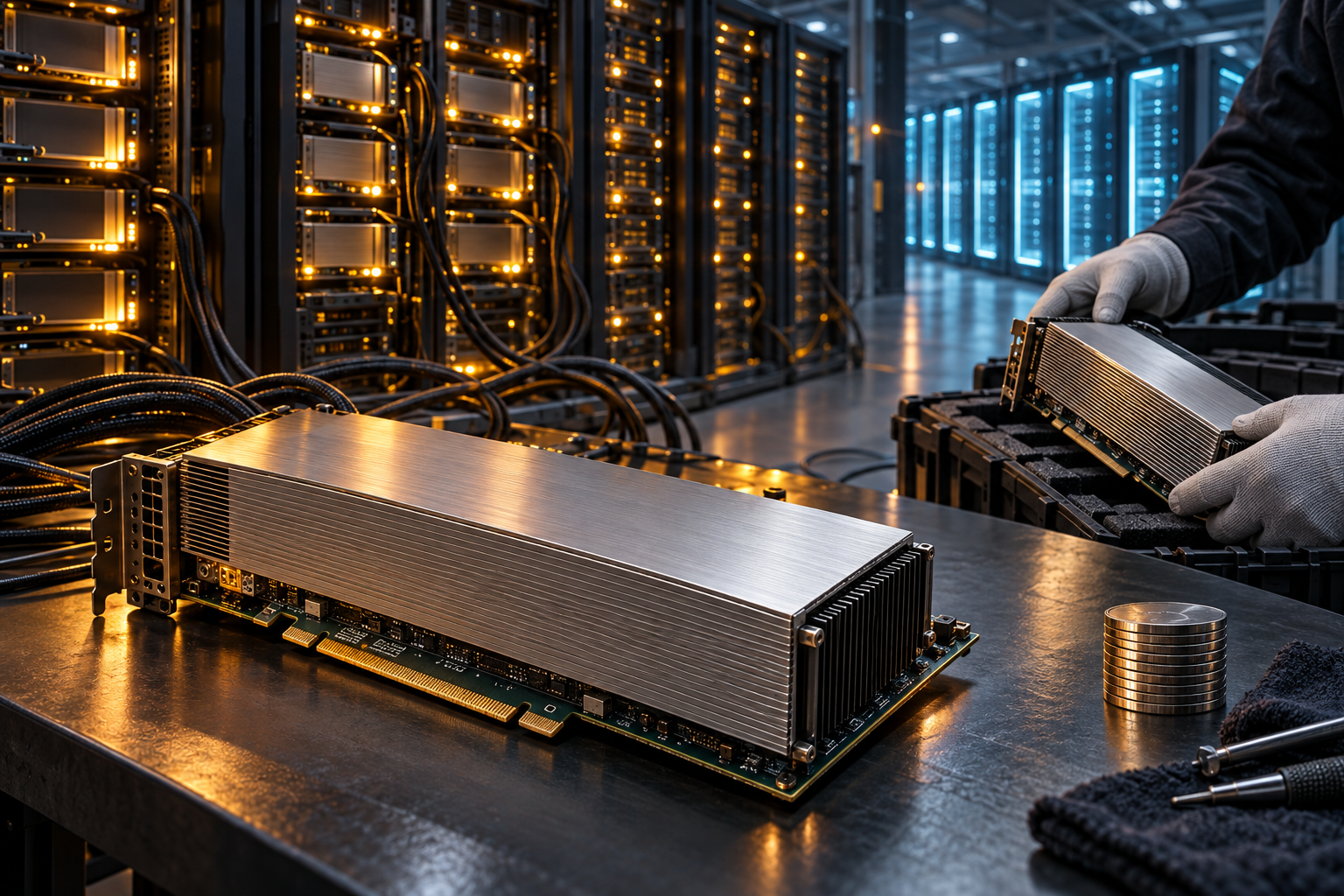
Assume you bought an H100 PCIe for $30,000. Published data put used transaction prices at $16,000–24,000. Applying $20,000, the midpoint of that range, means about 67% of the original purchase price remains in the equipment, while about 33% has disappeared from its price. This is the concrete case the article uses to answer how much value an older GPU retains after newer generations arrive.
How to read the numbers in the headline
$30,000 is an assumed acquisition price for comparison. $16,000–24,000 is the used transaction price range published by American Compute for the H100 PCIe. $20,000 is the arithmetic midpoint of that range. The observation period covers the trailing 12 months through August 2026. This article checked the public material on October 20, 2026.[1]
The analysis needs one more step. Even if the equipment price falls by $10,000, the investment can be recovered if operations have earned more than $10,000 in the meantime. This distinction connects an older GPU's resale price with its operator's returns.
1. Start by calculating what remains of $30,000
The device examined here is the card-style NVIDIA H100 PCIe 80GB, which slots into a server. Its configuration differs from an H100 SXM module, an H100 NVL, or an entire eight-GPU server. Below, the acquisition price is fixed at $30,000 per card and the published transaction range for that same product is applied.
| Price applied | Remaining value / percentage of acquisition price | Difference from acquisition price |
|---|---|---|
| Lower end of reported transactions | $16,000 / 53.3% | −$14,000 |
| Midpoint of the range | $20,000 / 66.7% | −$10,000 |
| Upper end of reported transactions | $24,000 / 80.0% | −$6,000 |
The answer in this case is ‘about $20,000 remains, with the reported transaction range equal to 53–80% of the acquisition price.’ The range captures differences that arise when equipment with different conditions, quantities, warranties, and transaction dates is represented by a single number.
The $10,000 that disappeared from the price is the gap between acquisition and resale prices. An accounting gain or loss on disposal compares the depreciated book value with the actual disposal proceeds. The economics of the GPU business also include operating revenue and expenses. Mixing these three calculations can exaggerate a price decline into a company loss, or hide an investment loss behind operating revenue.
2. Why do internet listings still ask $30,000?
A seller's asking price and the price of a completed transaction are different kinds of evidence. The figures checked for this article diverge substantially.
| Information | Published price | What was measured? |
|---|---|---|
| American Compute Trailing 12 months through August 2026 | $16,000~24,000 | A range the provider reports from completed used transactions.[1] |
| Caladan September 9, 2026 | $28,000~32,399 Median $32,000 | Asking prices collected from three individual-unit listings by US-based sellers.[3] |
| Clustermelt October 1, 2026 | Representative value $32,290 Range $28,000–32,399 | An indicator based on directly collected dealer listings and supplier asking prices.[4] |
American Compute says it uses completed transactions from brokers, resellers, and IT asset disposition firms, together with its own procurement data, while tracking asking prices separately. Individual transaction records are provided as anonymized aggregates. The $20,000 in this article is a valuation example applying that published range.[2]
Asking prices around $30,000, by contrast, are what sellers want to receive. Completed transactions are needed to establish whether buyers accepted those prices. Observation periods and sales channels also differ, so the entire gap cannot be interpreted as a negotiated discount. An actual October disposal price must be established through purchase offers for the same configuration, quantity, and condition.
The public evidence supports a clear conclusion. There is transaction evidence for H100 PCIe units in the upper teens to the twenty-thousand-dollar range, while public listings still carry higher asking prices. The headline therefore uses a benchmark from transaction data. Treating today's asking price as immediately recoverable cash can overstate the asset's value.
3. Why newer GPUs put downward pressure on older prices
Customers choose equipment that produces the same result at a lower cost. If a new GPU does twice the work at the same quality and response time, the older GPU must lower its rental rate or find another workload that suits it. When its expected income falls, a new buyer will pay less for the equipment.
A hypothetical example of how pricing pressure travels
Suppose the old GPU rents for $2 per hour, while the new one costs $3 per hour and performs twice as much of the same work. Using the new GPU for one old-GPU-hour of work costs $1.50. Other conditions being equal, the older equipment needs to cut its rate from $2 to around $1.50 to compete.
For equipment selling 500 hours per month, revenue falls from $1,000 to $750. If cash operating costs remain $300 per month, cash left over drops from $700 to $450, a decline of about 36%. This is how a 25% reduction in rental rates has a larger effect on earnings.
The process takes time. New equipment must be ordered, power, cooling, and networking prepared, and customer workloads migrated before older GPUs reach the used market. This creates a gap between a product announcement and large-scale disposals of the previous generation.
Demand also remains. Models that already run well, small-scale inference, development and testing, and scientific computing can be more economical on an existing setup. A facility short of power and space may value the throughput of newer equipment, while a buyer with spare capacity in an existing facility may value a cheap older GPU. These differences can support prices or widen their spread within the same generation.
4. A $10,000 price decline can still leave a profitable investment
Suppose a GPU bought for $30,000 is sold for $20,000. Adding what it earned during ownership completes the investment calculation.
| Item | Strong operating performance | Weak operating performance |
|---|---|---|
| Initial acquisition outlay | −$30,000 | −$30,000 |
| Cumulative net operating cash during ownership | +$14,000 | +$6,000 |
| Equipment sale proceeds | +$20,000 | +$20,000 |
| Removal, brokerage, transport, and other disposal costs | −$1,000 | −$1,000 |
| Final net cash difference | +$3,000 | −$5,000 |
Net operating cash here means rental receipts less power, hosting, networking, maintenance, and allocated operating labor costs. The example assumes no separate initial facility investment or additional replacement investment. The results are net cash differences before interest, taxes, and the time value of money; an actual business must include those items as well.
In both cases, the equipment price fell by exactly $10,000. Yet one operator recovered the purchase outlay and had $3,000 left, while the other was $5,000 short. A GPU operator's competitiveness depends on how much investment it recovers while equipment prices decline.
Scaling up makes the difference clearer. For 1,000 GPUs on the same terms, the reduction in equipment value is $10 million. The final net cash difference is +$3 million in the strong operating case and −$5 million in the weak case. This is why utilization, realized rental rates, and replacement timing matter alongside rapid revenue growth.
5. The hold-or-sell decision uses a different comparison
Even if the original purchase cost $30,000, today's decision compares what selling now would yield with what continued ownership would earn. Using the earlier price, assume the GPU can be sold for $20,000 now and is expected to be worth $14,000 one year later. The two amounts are compared on the same disposal-cost basis.
Because the equipment loses $6,000 in value over that year, net operating cash for the year must exceed $6,000 to more than cover the price decline. At $800 per month, annual net operating cash is $9,600, leaving $3,600 after the price decline. At $300 per month, it totals $3,600, leaving a $2,400 shortfall.
This is an initial comparison before the time value of money. The return available from investing the sale proceeds elsewhere, along with failure and idle-capacity risks, raises the return required to justify holding. A power-constrained facility must also consider the extra profit from replacing the old GPU with a new one and the additional replacement outlay.
Contracted paid usage makes the holding decision more concrete. Customers paying under long-term agreements improve the predictability of cash receipts. If no replacement customer can be found when the contract ends, electricity savings alone are unlikely to make up the investment recovery shortfall.
6. GPU prices do not all fall at the same rate
Even within the H100 family, installation requirements affect price. PCIe cards fit compatible servers, whereas SXM modules require the appropriate baseboard and system. A high-performance module may still have fewer buyers able to use it as a standalone component. Comparing individual modules with cards or complete servers can therefore seriously distort residual values.
Prices do not always move in one direction. For the same observation period, American Compute reports an H100 SXM transaction range of $10,000–14,000 and a year-over-year increase of about 10%.[5] Even with newer generations available, prices for a particular older product can rise as supply, demand, and the mix of buyers change.
There are examples of extended use as well. In an October 2026 article, NVIDIA described CoreWeave's extension of A100 bookings through 2029.[6] This supports the existence of customers who continue paying to use older equipment. Calculating the operator's return also requires knowing its acquisition cost, contracted rental rates, and operating costs.
7. Conclusion: about $20,000 remains; operations must recover the rest
Applying the midpoint of the reported transaction range to an H100 PCIe acquired for $30,000 leaves about $20,000, or roughly two-thirds of the original outlay, in the equipment. Net operating cash during ownership must cover the roughly $10,000 price decline, disposal costs, and financing costs.
Three numbers therefore matter when evaluating an older GPU: actual transaction evidence for the same product, net cash earned during ownership, and income contracted for the future. The first indicates what selling now may yield; the second shows the investment already recovered; the third explains why continued operation may be worthwhile.
GPU operators need to earn enough while their equipment can command valuable work, then choose its next use or sale timing in light of the remaining customers and prices. What the equipment earns while $30,000 becomes $20,000 determines the investment outcome.
Sources
- American Compute, H100 PCIe AppraisalTrailing 12 months through August 2026 · the provider's published completed-transaction range of $16,000–24,000. The article's $20,000 is the arithmetic midpoint of that range.
- American Compute, The Rack Report — MethodologyTransaction-data collection channels and aggregation methodology. Completed transactions and asking prices are treated separately.
- Caladan, Used NVIDIA H100 & A100 GPU Buying Guide 2026Updated September 9, 2026 · three US-based individual H100 PCIe 80GB asking-price listings collected through the eBay API. Range $28,000–32,399; median $32,000.
- Clustermelt, GPU Market Intelligence — October 2026As of October 1, 2026 · an H100 PCIe 80GB dealer/supplier asking-price indicator. Representative value $32,290. Distinct from completed transaction prices.
- American Compute, H100 SXM AppraisalTrailing 12 months through August 2026 · transaction range $10,000–14,000, up about 10% year over year. A different product configuration from PCIe.
- NVIDIA, AI Factories Are Productive, Durable, and Fungible InfrastructureOctober 1, 2026 · the manufacturer's account of CoreWeave extending A100 bookings through 2029.